
October 2026 has been a bad month to be a cargo thief in California — and a revealing one for everyone who ships through the state. In three separate October cases, law enforcement recovered more than $1.8 million in stolen train and warehouse freight across Southern California. Rail yard security is no longer a line item for railroads alone: any shipper, warehouse, or intermodal yard sitting near a rail corridor is now part of the same target map.
Three October Busts, One Pattern
San Bernardino County, October 16. The San Bernardino County Sheriff’s Department’s Rural Crimes Task Force served a search warrant at a San Bernardino home and arrested nine suspects in connection with an organized network accused of burglarizing Burlington Northern Santa Fe (BNSF) trains. Investigators say the network had been targeting trains for more than a year, stealing millions of dollars in property. Deputies recovered more than $330,000 in allegedly stolen merchandise — including computer hardware, speakers, shoes, and tools — along with four handguns, a surveillance drone, four vehicles, and suspected fentanyl.
Torrance, announced October 27. Los Angeles County Sheriff’s Department detectives announced the recovery of an entire shipment worth approximately $500,000 that had been taken in a fictitious warehouse pickup. Two men were arrested on suspicion of grand theft cargo after investigators traced the load to a warehouse near the 4200 block of West 190th Street in Torrance. SIG Sauer later clarified that the shipment contained air guns, not firearms or firearm parts — a reminder that thieves do not check manifests before they steal.
Los Angeles, October 21. The LAPD’s Cargo Theft Task Force, working with BNSF Police, Union Pacific Railroad Police, and other agencies, recovered $1,000,000 in stolen rail cargo — 35 pallets of shoes and backpacks — from a Chatsworth-area business, as Capital Guard Patrol Inc. covered in our earlier report on rail cargo theft prevention.
The pattern across all three cases is the same: organized crews, surveillance, and patience. These are not crimes of opportunity. They are planned operations against yards, warehouses, and rail corridors that look unguarded.
Cargo Theft Is the “New Normal”
Speaking at the American Trucking Associations’ 2026 Management Conference on October 20, cargo crime specialist Scott Cornell told the industry bluntly: “You are in the new normal.” Strategic theft — fraud designed to trick businesses into handing over freight — rose 1,475% from 2021 to 2024, he said, and reported losses capture only a fraction of the real cost. Industry tracker CargoNet captures roughly 1 in 10 full-truckload thefts, and an even smaller share of pilferage.
Southern California sits at the center of that map. An Overhaul report on regional cargo theft found that the 200-mile area around Southern California accounted for 37% of reported U.S. incidents, with nearly 70% of regional thefts occurring within 50 miles of Torrance — and deceptive pickups making up 28% of cases in the region. A yard in the Inland Empire, San Bernardino County, or the Los Angeles basin is not on the edge of the problem. It is the problem’s address.
What Rail Yard Security Actually Covers
Fences and cameras record crime; they rarely stop it. Rail yard security puts trained people at the points where theft actually happens:
Staffed gate and access control — Every truck, tractor, and visitor is verified against the load and access schedule before entering or leaving. A fictitious pickup dies at a staffed gate, because fake paperwork does not survive a guard who checks it.
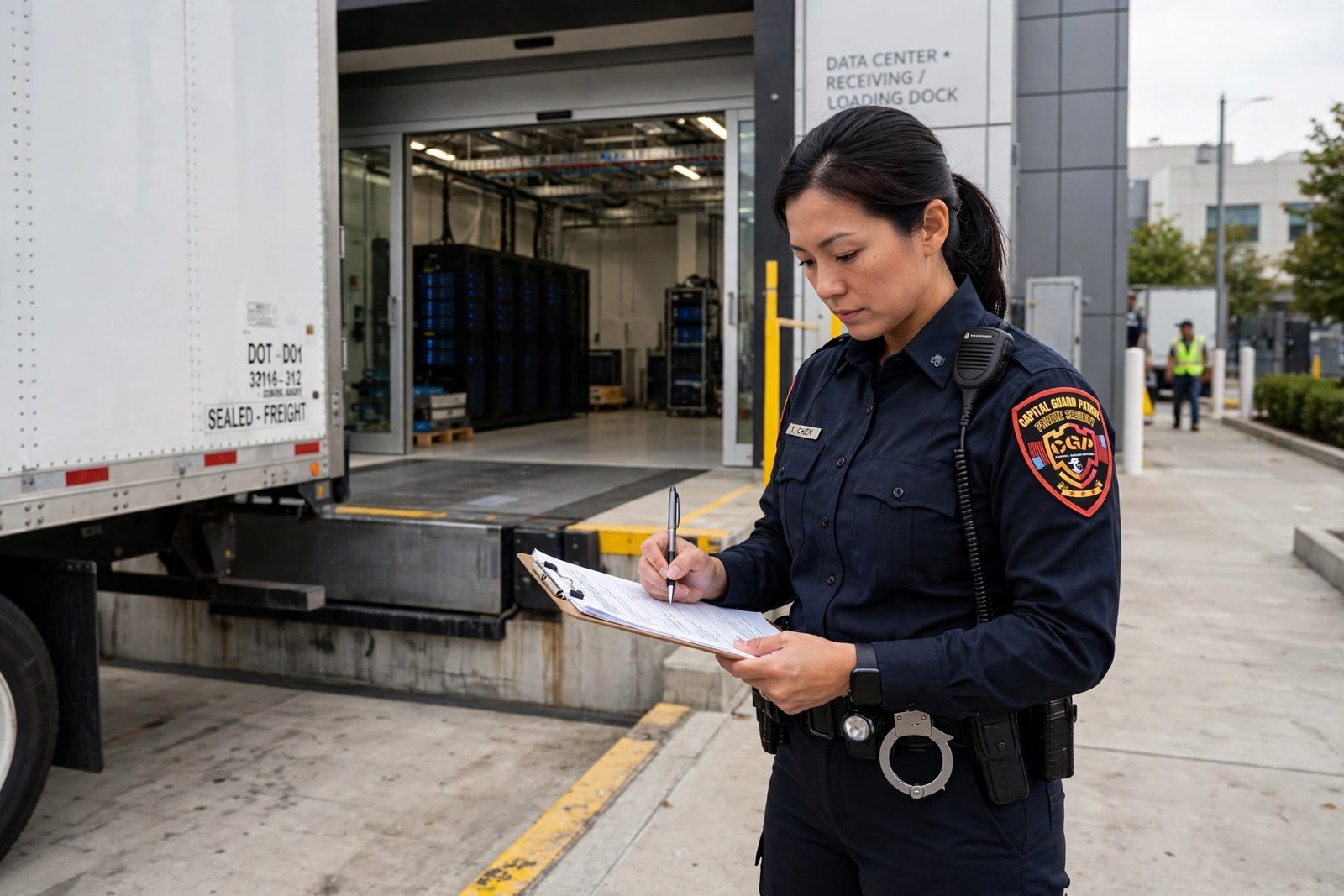
Randomized yard patrols and trailer checks — Guards walk the yard on unpredictable rounds, checking container and trailer seals, kingpin locks, and reefer units, and flagging equipment that has been sitting too long or moved without authorization.
Intermodal and dock monitoring — Loading, unloading, and transfer points get supervised so product does not walk out during a busy shift or a quiet night.
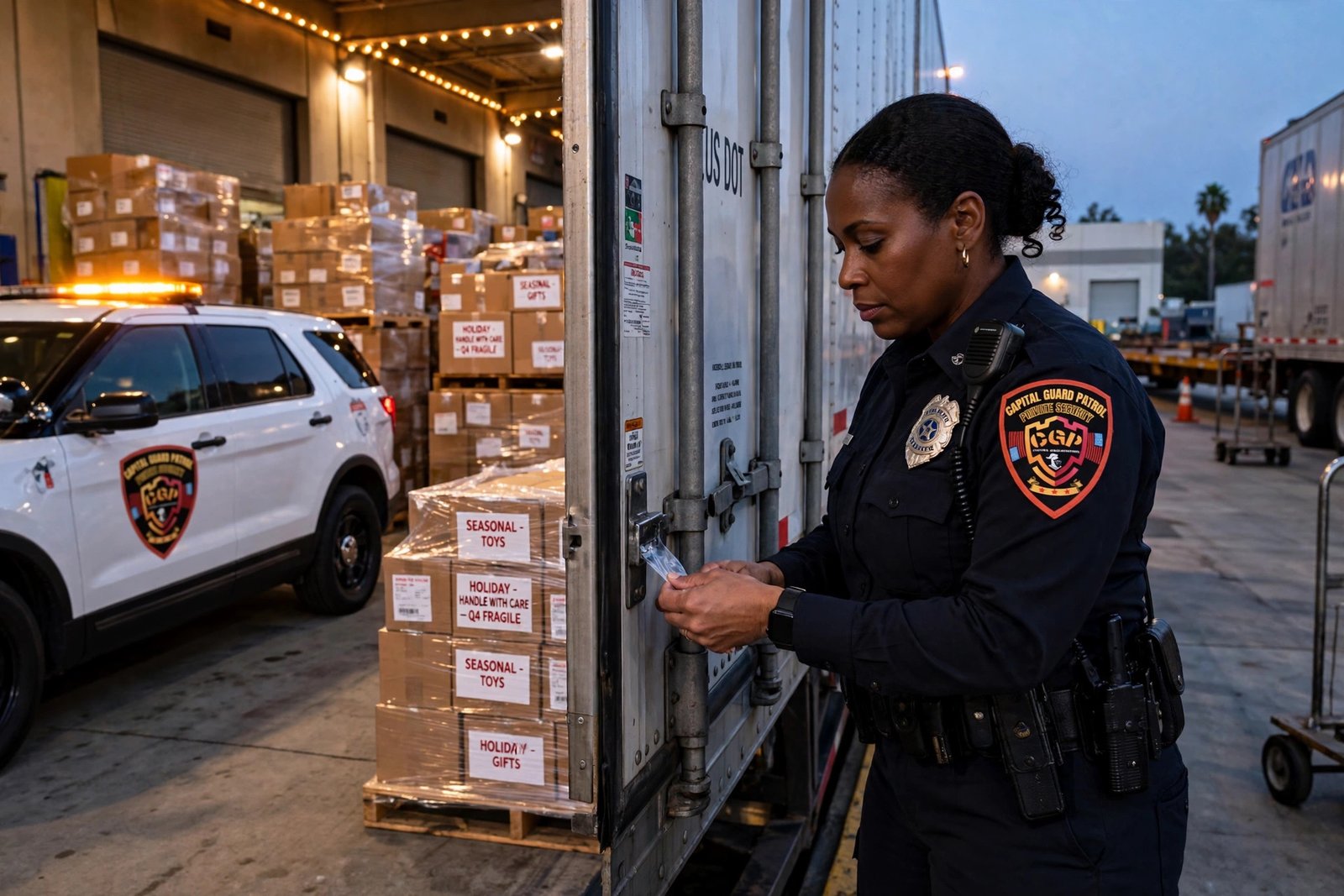
After-hours presence — Most rail and yard theft happens when the facility is dark. A marked patrol vehicle and a uniformed guard in the yard are the cheapest deterrents available — and the ones thieves notice first.
Documentation that holds up — Photos, timestamps, seal numbers, and gate logs from every shift give railroad police, sheriff’s investigators, and insurers the evidence they need. That matters when cases like October’s go to court: the busts above were built on months of investigation, and clean yard records are what make those investigations possible.
This is the same layered approach behind strategic cargo theft prevention — verify the carrier, verify the load, verify the person, and never let freight leave on a stranger’s word.
The Cost of Waiting for the Next Bust
October’s recoveries are good news for the victims, but recovery is not a strategy. Freight that has been stolen, handled, and resold is damaged, delayed, and often unrecoverable in full — and the investigation that recovers it takes months. A staffed gate and overnight yard patrol costs a fraction of a single lost load, and unlike a recovery, it prevents the loss in the first place.
If your facility sits near a rail line, an intermodal yard, or a warehouse corridor in Southern California, October’s busts are your warning: organized crews already know your yard. The question is whether anyone is watching it back.
Protect your yard before it becomes the next recovery story. Capital Guard Patrol Inc. provides rail yard security, freight yard patrols, and warehouse guard services across California, including Los Angeles, San Bernardino, the Inland Empire, and Orange County. Call (800) 640-1235 for a free yard security assessment.
Related reading: rail cargo theft prevention and our security guard services.
One Response